

Uber Presses For Legal Limits, the 60/40 Rule Personal Injury Firms Ignore, and How To Do Full-Funnel Marketing
Plus: Michele Mirman on Why Trial-First Firms Still Control the Game

👋 Good morning. Chris Dreyer here. Uber is pushing back hard against personal injury litigation in California, backing proposals that would cap attorney fees at 25% and restructure how costs get calculated. The company argues plaintiffs’ firms are expanding liability beyond what state law allows. For PI firms handling rideshare cases, this is worth tracking closely.
Also in this edition, there’s a budget allocation principle most PI firms ignore that directly affects long-term growth. Let’s call it “The 60/40 Rule,” and it challenges how law firms typically allocate their marketing budget. I explain why this matters, where you should invest resources, and what happens when firms get the balance wrong.
But understanding the principle is one thing. Execution is another. Today, I’ll walk you through how to build a full-funnel marketing strategy that actually works, from awareness at the top to conversion at the bottom, so you can maximize caseload without wasting budget on the wrong channels. Let’s dive in...

You’re reading PIM Newsletter, the weekly intelligence briefing for personal injury firm owners and managing partners. Each week, we deliver the strategies, tactics, and industry insights that move the needle on revenue and caseload. PIM Newsletter is brought to you by Rankings.io, the law firm growth agency helping PI firms dominate AI search and turn visibility into cases. Learn more →

The 60/40 Rule Personal Injury Firms Ignore at Their Own Risk
The logic is understandable. No serious personal injury firm obsesses over SEO, CAC, GEO, or PPC for their own sake. Not really. What they want is more cases. And getting more cases means allocating budget to whatever produces a win. For many personal injury firms, that’s performance marketing.
A Google Ads campaign here.
A retargeting push on Facebook.
Yet another email series.
And it works, largely because the internet has made it easy to measure just about everything.
Firms can more or less see which clicks lead to calls, which ads convert to signed cases, and which landing pages outperform. That feedback loop is especially seductive in a highly competitive market where no single PI firm owns more than 5% of the market.
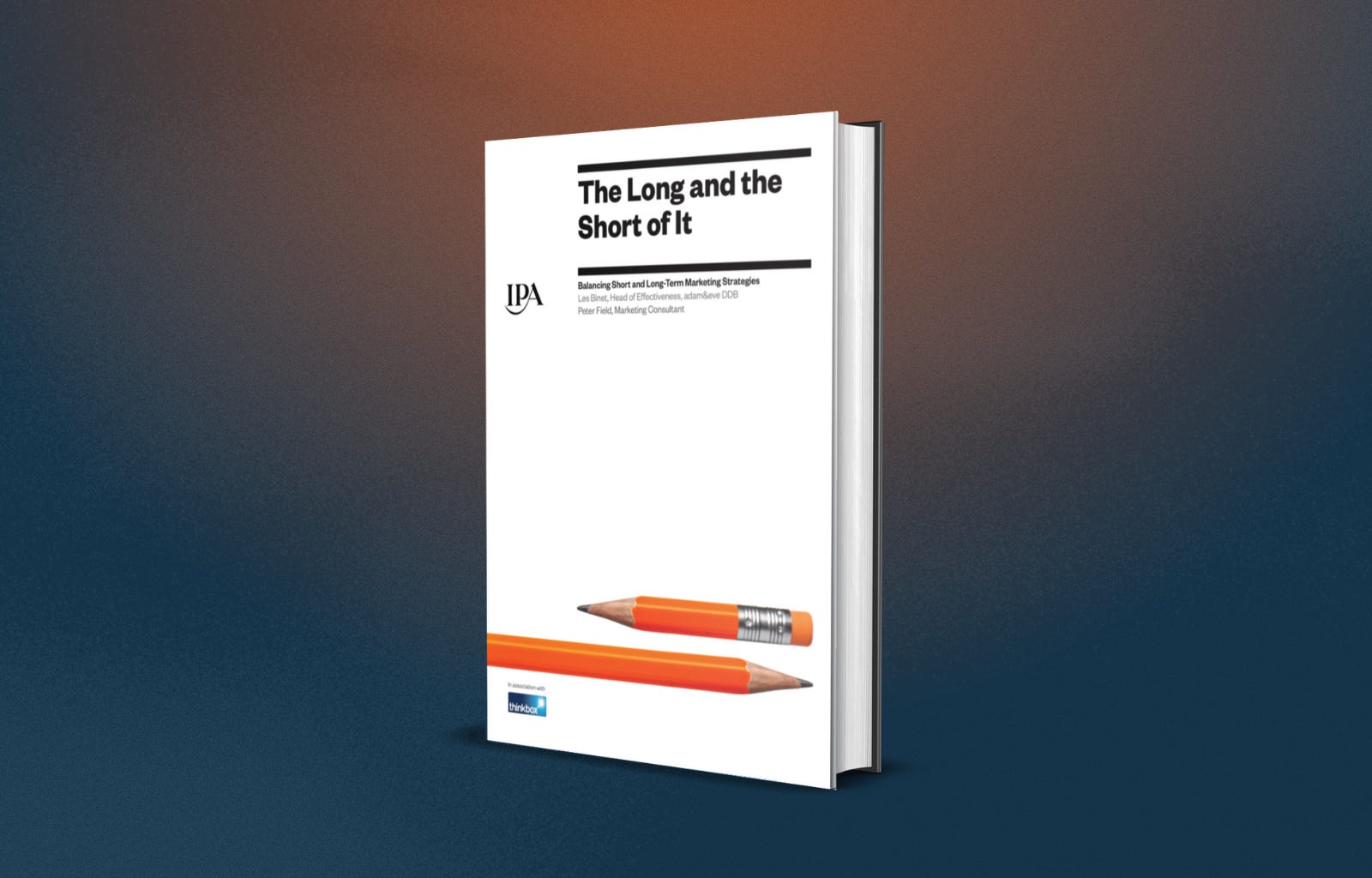
But years-long research into marketing effectiveness suggests this default to short-term performance marketing is a mistake, and a costly one at that. The seminal book sounding the alarm is The Long and the Short of It: Balancing Short and Long-Term Marketing Strategies by Les Binet and Peter Field, published 13 years ago, yet still remarkably relevant today. The authors showed how brands that consistently prioritize short-term activation tend to underinvest in brand marketing, which is where they build trust and where growth compounds over time.
Other experts have come to a similar conclusion. Not too long ago, the Wall Street Journal reported that advertising executives across industries reassessed performance-heavy strategies after finding that short-term efficiency gains often came at the expense of long-term demand, pricing power, and brand recall.
Independent measurement backs that finding. A cross-media study led by Nielsen, alongside Nepa and GfK, found that long-term returns account for roughly 60% of total advertising ROI across channels, with short-term returns making up the remainder. The research showed that focusing only on immediate sales materially undervalues brand activity, including in digital channels, and systematically understates its contribution to future demand and revenue.
And the same study dispels another myth I see in legal marketing…
“Digital media is not for short-term only.”
A few thoughts…
Bottom-of-funnel buyers are a small slice of the market. Based on the famous marketing heuristic known as the 95:5 Rule, it’s reasonable to assume that in a typical PI funnel, the people at the decision stage, the ones ready to call after searching “personal injury lawyer near me,” represent only about 5% of potential buyers at any given time. Not a hard-and-fast number, but the point stands: Short-term performance marketing is built to win that 5% through paid ads, retargeting, lead buys, and conversion rate tweaks. The catch is that it does almost nothing for the other 95%, the people who might one day need your firm but don’t need a lawyer today. Capturing that larger group requires brand building, because brand creates familiarity, trust, and recall before the moment of urgency.
Budget allocation matters more than ever. Binet and Field’s research shows that most firms overinvest in short-term activation because it is easier to measure and easier to defend internally. Their work points to a general sweet spot of roughly 60/40, with 60% allocated to brand building and 40% to activation. Performance marketing can drive cases this month. Brand investment ensures you can capture demand next year.
What this means for PI firms is practical, not abstract. Rebalance budgets so short-term activations do not crowd out long-term brand work. Clarify roles: Paid search, LSAs, retargeting, and lead buys exist to harvest existing demand, while brand channels such as broadcast, streaming, sponsorships, PR, consistent content, and organic visibility shape memory and trust. Measure both accordingly. Firms that do this well set distinct objectives for short-term wins and long-term growth and build systems where each reinforces the other over time instead of competing for budget.
If this feels familiar, now is the time to hit reset on your marketing strategy for 2026. Performance marketing can drive cases, but it does not scale indefinitely. And you certainly can’t afford to ignore your future clients.
The book spells out what personal injury firms should do differently once growth slows.
🔗 The Long and the Short of It: Balancing Short and Long-Term Marketing Strategies →

How To Do Full-Funnel Marketing (And Why You Should)
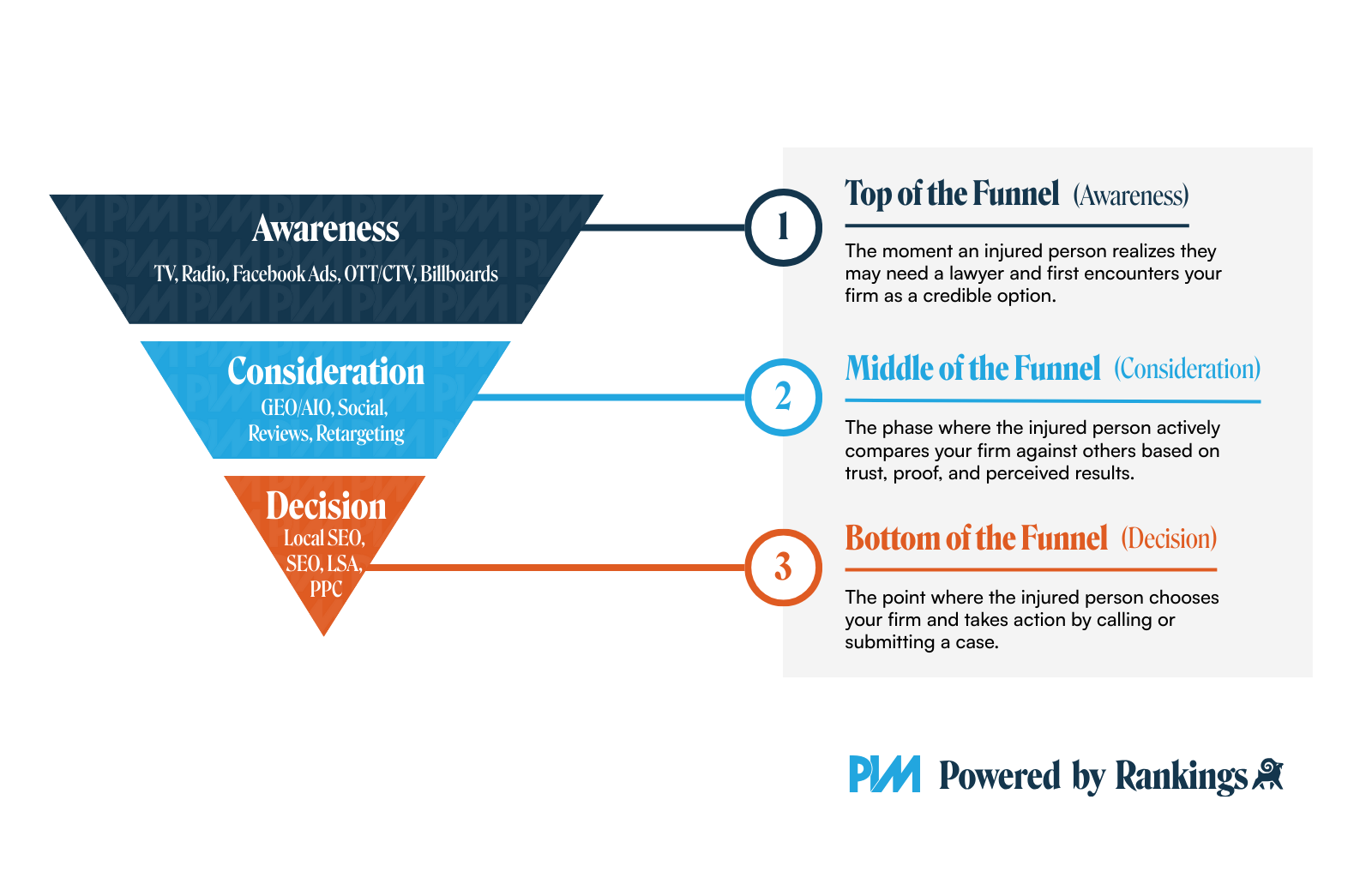
Once you accept that brand and performance serve different jobs, the next step is applying that thinking across the funnel. That starts with being clear about what each stage should do and updating your content and channel strategy accordingly.
You’ll also need to be clear about who your ideal customer is. Who are you trying to reach? Can you describe their motivations or preferences? Do you know where they hang out online? Once you have these fundamentals in place, execute a full-funnel marketing strategy.
Your full-funnel strategy can be the difference between success and failure. You either see a regular stream of cases or your phone never rings.
Here’s one approach to consider:
At the top of the funnel, brand marketing should do the heavy lifting. This stage exists to create awareness and familiarity at scale. TV, radio, billboards, sponsorships, Facebook ads, OTT, and CTV all belong here when you use them to tell a consistent story, not chase immediate leads. The objective is simple: Make sure people in your market recognize your firm before they ever need a lawyer. Performance tactics can help distribute the message, but brand is doing the job.
In the middle of the funnel, brand earns trust and performance reinforces it. This is the consideration stage. People know your name and now want to know if you are credible. Reviews, testimonials, community involvement, legal authority content, and social proof matter here. Retargeting belongs here because it keeps your firm present once interest begins. GEO and AI-driven search influence also shows up at this stage, as people ask comparison questions and look for validation. If this layer is weak, bottom-of-funnel spend gets more expensive and less predictable.
At the bottom of the funnel, performance takes the lead. This is where intent is highest and clients make decisions about which law firms to hire. Local Services Ads, Google Ads, PPC, local SEO, SEO, and Yelp ads belong here and firms should judge them on efficiency and cost per signed case. Brand is not being built at this stage. It is being cashed in. Firms convert more consistently when people already recognize the name, trust the reputation, and feel confident picking up the phone. That confidence comes from earlier brand work. It does not originate here, but it shortens the decision when it matters most.
Full-funnel marketing is how brand and performance stay in balance. Brand creates demand over the long term. Performance marketing captures it sooner, when timing is right and the customer is ready to make the call. The firms that scale most reliably align budgets (don’t forget the 60/40 is the sweet spot) and messaging to that reality. And they don’t just measure results on the performance side. No, they deploy tools to track brand awareness, recall, and share of search.
Keep reading…I give you the skinny on one of these brand monitoring tools below.
🔗 Why every business needs a full-funnel marketing strategy →

Uber Presses for Legal Limits as Crash Lawsuits Mount in California

Uber is pushing back against a growing wave of personal injury lawsuits in California, arguing that plaintiffs’ firms are attempting to expand the company’s legal exposure beyond what state law allows. As rideshare-related crash cases increasingly name Uber itself rather than individual drivers, the company is pressing courts and lawmakers to reinforce limits on liability, according to the Los Angeles Times.
“Uber’s proposal would cap attorney fees for car crash cases at 25% and require extra costs — filing fees, depositions, experts — to be calculated before the fee split rather than coming out of the client’s portion.” - LA Times
Uber is facing an increasing volume of high-stakes injury litigation. Many of the lawsuits involve catastrophic injuries and plaintiffs’ firms have structured them to reach Uber’s insurance coverage, rather than relying solely on policies individual drivers hold.
Plaintiffs’ firms are advancing platform-based liability theories. The cases focus on Uber’s control over pricing, dispatch, and driver rules through its app, arguing that these features place the company closer to an operating transportation provider than a neutral technology platform.
Uber is pushing for concrete legal limits that would directly affect personal injury firms. The company has backed a proposal that would cap attorney fees in car crash cases at 25 percent and require litigation costs such as filing fees, depositions, and expert expenses to be calculated before fees are split, rather than deducted from the client’s recovery. Uber says the changes prevent what it describes as abusive litigation practices.
The fight is unfolding in California courts and policy debates, with personal injury firms and rideshare companies now openly contesting how far liability and fee structures should extend in crash litigation.

AI Hallucination Cases Now At 563 So Far: A public database maintained by Damien Charlotin, a research fellow at HEC Paris, has recorded 563 U.S. court decisions so far in which judges identified AI-generated hallucinations, including fabricated citations, false quotes, and misrepresented legal authority. The cases span federal and state courts and involve both attorneys and pro se litigants, underscoring how frequently AI errors are now surfacing in routine litigation. Recent entries include a Middle District of Florida case in which a judge imposed $7,000 in adverse costs after finding that filings relied on fabricated case law.
Condo Association Faces Wrongful Death Suit Over Delivery Box Trip: The estate of a Connecticut condominium resident sued a condo association, its property manager, a landscaping contractor, Chewy Inc., and FedEx Corp. after the resident fatally tripped on a Chewy delivery box left outside a unit door in January 2024. The lawsuit alleges the defendants allowed the box to remain in an obstructive and dangerous location and failed to remove it or warn residents. A state judge allowed the claims to proceed, and the case is in discovery.
Private Equity Pushes Deeper Into U.S. Personal Injury Law: Private equity firm Uplift Investors agreed to back Louisiana-based personal injury firm Dudley DeBosier through a structure that gives lawyers majority ownership while shifting business operations to a Managed Services Organization (MSO). The arrangement allows the firm to pursue national expansion while complying with U.S. rules barring nonlawyers from owning law firms, according to the Financial Times. Lawyers will retain control of legal services, while the MSO will handle technology, finance, and other back-office functions in exchange for fees, reflecting growing investor interest in alternative ownership models in the personal injury sector.
Snapchat Settles to Avoid First Social Media Bellwether Trial: Snap Inc. reached a settlement with a plaintiff accusing Snapchat of contributing to teen mental health harms, resolving the case days before it was set to become the first social-media bellwether trial in Los Angeles County Superior Court. The deal removes Snap from the upcoming trial, which will proceed against other defendants in coordinated litigation targeting major social platforms. The settlement does not resolve the broader docket, which includes more than 1,000 cases alleging that social media design features harm young users.
J&J Talc Plaintiffs Cleared to Present Cancer Causation Experts: A court-appointed special master recommended that plaintiffs suing Johnson & Johnson over talc products be allowed to present expert testimony linking genital talc use to ovarian cancer, a key evidentiary hurdle in litigation involving more than 67,500 federal cases in New Jersey. Retired U.S. District Judge Freda Wolfson found the plaintiffs’ experts used reliable methodologies under federal standards, while also allowing J&J experts to testify and excluding some plaintiff theories.
RFK Jr. Signals New FDA Review of Heavy Metals in Baby Formula: Secretary of Health Robert F. Kennedy Jr. said the Food and Drug Administration plans to release results in April from a review examining heavy metals in infant formula, including cadmium, mercury, and lead. The study stems from the FDA’s “Operation Stork Speed,” launched after a 2023 laboratory analysis found detectable heavy metals in dozens of baby food products. Kennedy said the review will inform potential regulatory and nutrition standard updates, as lawmakers and regulators continue to scrutinize contamination risks in infant and children’s products.


The Supreme Court unanimously ruled last week that state medical malpractice pleading requirements do not apply in federal court. In a 9–0 decision, the justices held that federal procedural rules govern how medical malpractice claims proceed in federal court, even when state law would otherwise impose stricter filing requirements.
The case grew out of a malpractice suit brought by Paul Berk Jr. Berk alleged that doctors at Beebe Medical Center in Delaware failed to properly treat an ankle injury that ultimately required surgery and led to complications. He filed his lawsuit in federal court rather than state court.
Delaware law required an affidavit of merit at the outset. The state’s medical malpractice statute mandates that plaintiffs submit an affidavit from a qualified medical expert attesting that reasonable grounds exist for the claim. Berk did not file such an affidavit with his complaint.
Lower courts split on whether the state rule applied. The federal district court dismissed Berk’s case for failing to comply with Delaware’s affidavit requirement, and the Third Circuit affirmed, finding the state statute substantive enough to apply in federal court.
The Supreme Court rejected that approach. Writing for the Court, Justice Ketanji Brown Jackson explained that Rule 8 of the Federal Rules of Civil Procedure governs what a plaintiff must plead in federal court and leaves no room for additional state-law filing hurdles. Because Rule 8 squarely addresses the issue, it displaces Delaware’s affidavit requirement in federal proceedings.
The Court concluded that when federal procedural rules directly address how a claim must be pleaded, they control, even if the result differs from what state medical malpractice law would require.

Why Trial-First Firms Still Control the Game

I have talked to a lot of firm leaders over the years, but Michele Mirman’s story keeps coming back to one thing. Early on, she learned that if you are not prepared to try cases, you are building a firm around someone else’s leverage. That lesson shaped how her firm Mirman, Markovits & Landau hires, trains, selects cases, and negotiates. It is also why they’ve stayed dominant as the PI market has become more crowded and more settlement-driven.
Some notable plays that stood out from my conversation with Michele Mirman:
Build the firm as if every case could go to trial. Mirman does not assume cases will settle, even though most do. The firm prepares from day one as if a jury will see the evidence. That posture changes how the firm builds files, how it uses experts, and how the defense approaches negotiations.
Use trial readiness to set leverage long before mediation. Defendants respond differently when they know a firm can and will try cases. Mirman explained that settlement values often rise not because of last-minute pressure, but because the other side sees early signals of preparation and credibility.
Train lawyers to think like trial lawyers from the start. Mirman, Markovits & Landau exposes associates to real trial work early rather than parking them in research roles for years. They learn how to build narratives, how juries react, and how early decisions affect outcomes later. That experience sharpens judgment across the entire docket.
Treat preparation as strategy, not overhead. Focus groups, expert prep, and theme testing happen well before trial dates appear. Even when cases resolve early, that work clarifies strengths and weaknesses and reduces surprises. The firm buys clarity, not just readiness.
Let culture filter for accountability. A trial-first environment attracts lawyers who want responsibility and deters those looking for shortcuts. Mirman described how this mindset shapes hiring, retention, and internal standards without needing constant enforcement.
What stayed with me is that Mirman does not argue that every case should go to verdict. She argues that firms that can try cases control their future. They negotiate from strength, train better lawyers, and build reputations that compound over decades.
Here’s my full conversation with Michele Mirman…
🎧 Personal Injury Mastermind: Episode 357 →


A Tool to Measure Brand Awareness, Trust, and Recall (Not Just Campaigns)
Most personal injury firms track leads, calls, and cases, but far fewer can say how the market actually perceives their brand. BERA provides that intel. The platform focuses on measuring brand awareness, sentiment, and emotional connection over time, giving firms a way to understand whether their marketing is building long-term trust or simply generating short-term activity.
“Brand growth shows up long before conversion. The firms that win are the ones people already recognize and trust when something happens.”
BERA tracks brand sentiment and awareness, not just surface-level exposure. Instead of relying on impressions or engagement alone, the platform analyzes how people discuss a firm across digital channels to assess trust, favorability, and emotional response. For PI firms, this helps distinguish between visibility that fades and awareness that actually sticks.
Brand-health data ties marketing efforts to long-term positioning. BERA’s reporting allows firms to see how campaigns, content, and media activity influence awareness and sentiment over time. This is especially relevant for firms investing in video, thought leadership, and community-facing marketing that may not drive immediate conversions but shapes future demand.
Competitive benchmarking provides real market context. The platform compares brand strength against local and regional competitors, highlighting gaps in recognition and trust that traditional analytics tools do not surface. In crowded PI markets, those gaps often explain why similar firms see very different results.
For personal injury firms, the value here is strategic. Cases rarely come from the first touch alone. They come from being remembered, trusted, and recognized at the moment someone needs help. Tools like BERA are not about optimizing ads week to week. They are about understanding whether a firm’s brand earns mindshare over time.
Before you go
Disclaimer: Personal Injury Mastermind takes all reasonable steps to ensure accuracy in the materials we share, including articles, newsletters, and reports. These materials are intended for general informational purposes only and do not constitute legal advice. They may not reflect the most current laws or regulations. Always consult a qualified attorney for advice on a specific legal matter.


Thanks for reading. Quick ask…if you know someone who’d benefit from this content, please forward this to them. I’ll be back next week. - Chris
Received this newsletter from someone else? Subscribe below. Questions? Contact us at newsletters@rankings.io.